
What Kind of Educational Impact Do You Care About?
Every student has potential, but not every student has the same opportunities.
Sometimes the right support at the right time can help a student understand a difficult subject, discover a strength, find the right learning environment or begin to see a future that once felt out of reach.
Beginning in 2027, the Federal Scholarship Tax Credit (FSTC) gives taxpayers a new way to help create those opportunities through qualifying contributions.
How Does the Federal Scholarship Tax Credit Make This Possible?
Beginning January 1, 2027, the Federal Scholarship Tax Credit (FSTC) gives eligible taxpayers a new way to support K-12 educational opportunities through qualifying cash contributions to eligible Scholarship Granting Organizations (SGO).
Eligible individual taxpayers may claim a nonrefundable federal income tax credit of up to $1,700 each year, while married couples filing jointly may claim a combined credit of up to $3,400, subject to qualifying contributions and applicable federal requirements.
The FSTC is a tax credit, not a tax deduction. Because the credit is nonrefundable, the amount a taxpayer can use depends on qualifying contributions, available federal income tax liability and applicable federal requirements.
The federal credit makes participation possible. The educational opportunity your contribution helps create is what makes it meaningful.
Scholarkids provides general educational information and does not provide individual tax advice. Always consult your tax advisor.
How Your Choices Help Shape the Impact
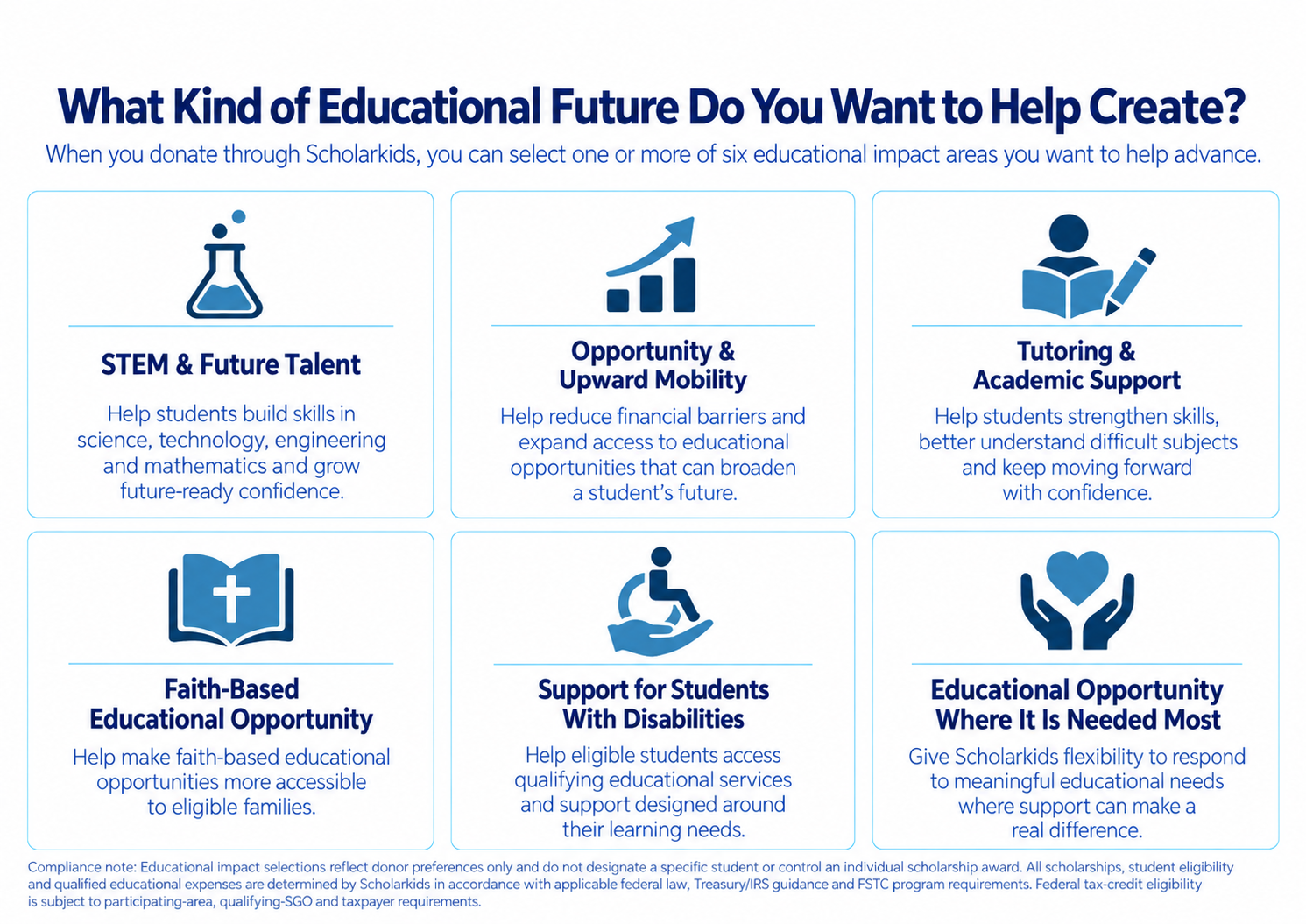
When you donate, you can select one or more of the educational impact areas you want to support. Scholarkids combines the selections made by donors and uses them to guide how funds available for scholarships are proportionally allocated across the six impact areas, based on the overall share of donor selections and subject to federal requirements and available qualified scholarship needs.
This means the causes donors care about collectively help shape the educational impact of the Scholarkids FSTC program.
Your selections do not designate a particular student or give a donor control over an individual scholarship. Under federal law, contributions may not be earmarked or set aside for a particular student. Scholarkids independently verifies eligibility, selects scholarship recipients and determines scholarship awards in accordance with applicable federal requirements.

Who May Qualify for a Federal Scholarship?
Federal scholarships are intended to help eligible K–12 students access qualified educational opportunities and support.
A student may generally qualify if they meet applicable federal household-income requirements and are eligible to enroll in a public elementary or secondary school.
Eligible students may attend different educational settings, including public, private, religious, or homeschool environments, depending on applicable federal requirements and the qualified educational expenses being supported.
Scholarkids will verify eligibility before a scholarship is awarded. Meeting the basic eligibility requirements does not guarantee a scholarship, as awards are also subject to available funding and applicable federal priority requirements.
More Than Tuition
Educational opportunity is not always just a tuition bill.
Sometimes it is the tutor who helps a student understand a difficult subject.
Sometimes it is the right curriculum, testing opportunity or educational service.
Federal scholarships may support a range of qualified K-12 educational expenses permitted under federal law. Examples may include:
- School tuition
- Tutoring and educational classes
- Curriculum, books and instructional materials
- Testing
- Certain dual-enrollment expenses
- Certain educational therapies and services
- Computers, technology and other qualifying educational equipment
The expenses that qualify depend on applicable federal requirements and current Treasury/IRS guidance.
These are the practical supports that can turn an educational opportunity into something real for a student: a lesson understood, a skill strengthened, a barrier reduced or a new path opened.
Why Give Through Scholarkids?
The federal tax credit may be what first introduces you to the program.
The educational opportunity you can help create is the reason to give.
Your contribution can help:
- A curious student discovers a future through STEM.
- A family overcomes a financial barrier to educational opportunity.
- A student receives the tutoring they need to regain confidence and keep moving forward.
- A family accesses a faith-based educational environment important to them.
- A student with a disability receives qualifying support designed around how they learn.
- Make educational support available where the need is greatest.
When you donate, you can choose one or more of the educational opportunities that moved you to give.
Your choices help keep Scholarkids’ scholarship program connected to the educational causes donors care about, while Scholarkids retains responsibility for eligibility, individual scholarship decisions and compliance with federal requirements.
Does the Federal Scholarship Tax Credit Take Money Away From Public Schools?
No. The Federal Scholarship Tax Credit is structured as a separate federal tax credit for qualifying cash contributions that individual taxpayers voluntarily make to approved Scholarship Granting Organizations. It does not directly transfer or reallocate funds already appropriated to an existing public-school budget.
On the contrary, qualifying contributions create an additional source of scholarship support for eligible students and qualified K-12 educational expenses, for students of public and private schools alike!
Depending on a student’s needs and applicable program requirements, scholarship support may help with expenses connected to public, private or religious education, as well as tutoring, instructional materials, testing and certain educational therapies.
The goal is to create additional pathways to educational opportunity for all eligible students.
Choose Where You Want to Make an Impact
When you are ready to contribute, the donation page will also give you the opportunity to choose the available states where you would like your contribution to be used.
Each available state will be clearly identified before you complete your contribution. This gives you another way to decide where your support can make a difference while keeping the focus on the educational impact you want to help create.
The federal credit limit does not change based on which available state you select. Regardless of where you live in the US, your contribution is eligible for the Federal Scholarship Tax Credit, subject to applicable federal requirements and your individual tax situation.
Wherever you choose to make an impact, your contribution helps Scholarkids create meaningful educational opportunities for eligible students.
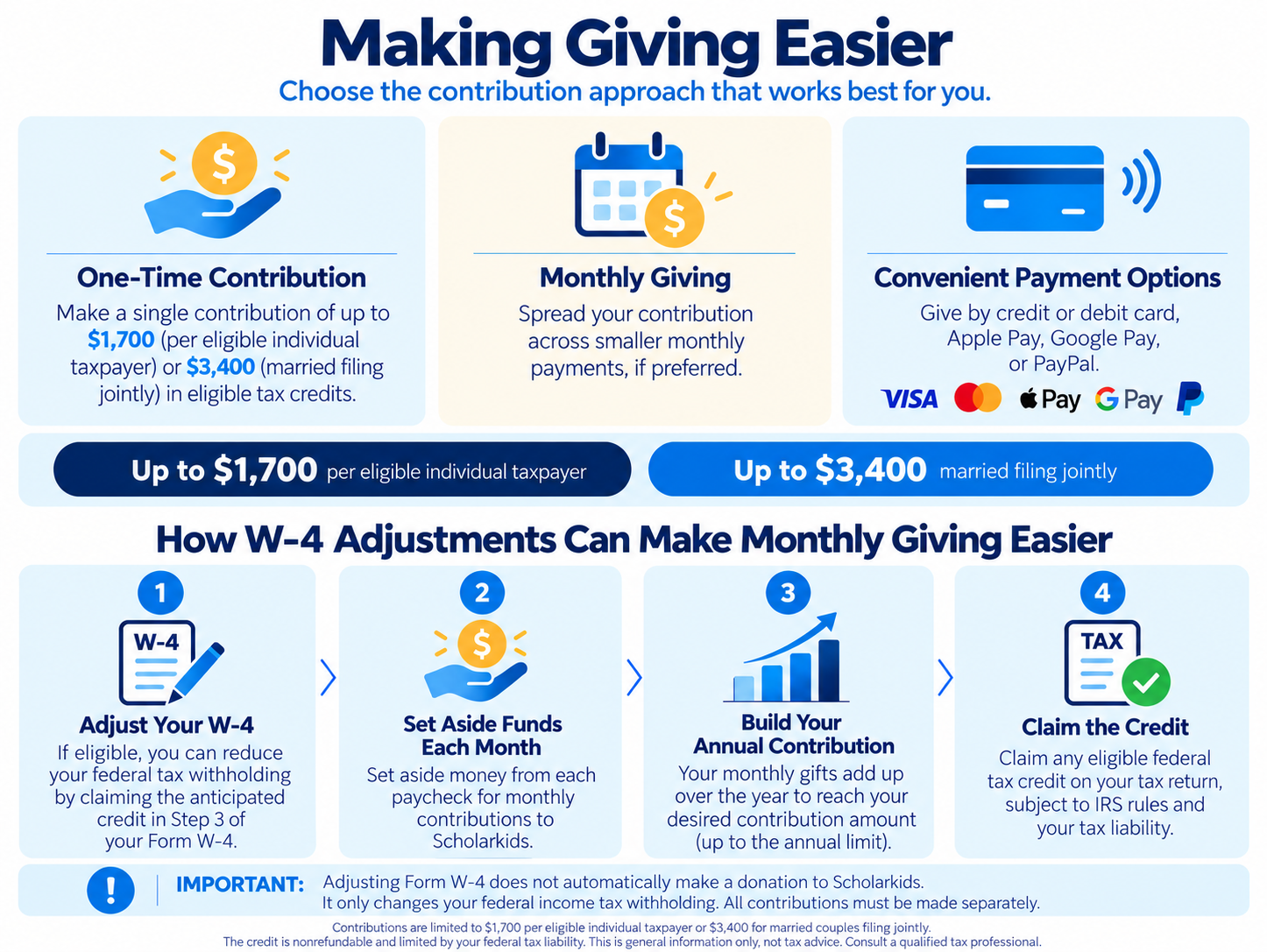
Click here to watch the video: Learn how W-4 adjustments can help make monthly contributions
Click here to view or download the flyer: Discover how the Paycheck Swap works in four simple steps
Interested in the Federal Scholarship Program?
Whether you are interested in making a future federal tax-credit contribution, exploring scholarship opportunities, or receiving program updates, we’d be glad to keep you informed.
Scholarkids is preparing for the Federal Scholarship Tax Credit program beginning in 2027. Federal contributions and scholarship applications through Scholarkids are not yet available.
Scholarkids provides general educational information and does not provide tax, legal or financial advice. Federal Scholarship Tax Credit eligibility depends on applicable federal law, current Treasury/IRS guidance, program requirements and each taxpayer’s individual circumstances. Scholarkids’ participation is subject to required approval and listing under the FSTC program.
Frequently Asked Questions
Do I have to contribute the full credit amount?
No. An eligible individual taxpayer may make a qualifying contribution below the $1,700 annual individual credit limit and married couples filing jointly may qualify for a combined credit of up to $3,400. The amount of credit a taxpayer may actually claim depends on qualifying contributions, available federal income tax liability and applicable federal requirements.
What happens if I cannot use the full credit in one year?
The FSTC is nonrefundable, so it cannot reduce your federal income tax liability below zero. However, unused eligible credit may generally be carried forward for up to five years, subject to applicable federal requirements and your individual tax situation.
I don't have children. Can I still contribute?
Yes. You do not need to have a child receiving a scholarship in order to make a qualifying contribution. Eligible taxpayers may participate subject to applicable federal requirements. The tax benefit available to each taxpayer depends on the taxpayer’s individual circumstances.
Can I claim both the FSTC and a federal charitable deduction for the same contribution?
No. A contribution for which the Federal Scholarship Tax Credit is allowed cannot also be claimed as a federal charitable contribution deduction for that same amount. Taxpayers should consult their tax professional regarding their individual circumstances.
Can the same contribution qualify for both a federal and a state tax credit?
Federal law provides that the Federal Scholarship Tax Credit is reduced by the amount of any state tax credit allowed for the same qualified contribution. This means the interaction between federal and state credits depends on the contribution and the applicable state program. Separate contributions are not stated as a federal requirement simply because both programs may be available. Taxpayers should consult their tax professional to determine how federal and state credits apply to their individual circumstances.
Can I direct my federal contribution to a particular student?
No. Federal law prohibits an SGO from earmarking or setting aside contributions for scholarships on behalf of a particular student. Donors may express permitted educational-impact preferences offered by Scholarkids, but Scholarkids independently determines student eligibility and scholarship awards.
Can I direct my contribution to a specific geographic area?
Yes. absolutely. Scholarkids is constantly adding the list of States in which the donors’ contributions can be directed, to create educational outcomes. However, the primary guiding principle is always the impact areas you care about most.
Can I donate stock to Scholarkids and receive the Federal Scholarship Tax Credit?
No. The Federal Scholarship Tax Credit applies only to qualifying cash contributions. You may donate stock to Scholarkids as a regular charitable contribution to our 501(c)(3) organization, but stock donations do not qualify for the Federal Scholarship Tax Credit. Any potential charitable tax deduction is subject to applicable IRS requirements.